
Reviewed · NORTHERN HISTORIC ROUTE
12- Day Historical Route of Ethiopia
Ethiopia’s best stories are written in stone, churches, and ancient cities. This 12-day route strings together major UNESCO stops and lesser-seen Christian sites, with domestic flights and a small-group pace so you spend more time looking and less time sorting out logistics.
I really like the small group size (max 4), it keeps the day smooth and makes it easier to adjust when road time runs long. I also love that you get a real guided plan with domestic flights and a professional multilingual guide, plus meals and entrance fees largely handled for you.
One thing to consider: you do have several long drive days and at least one outing at higher altitude in the Simien Mountains. If you have only light interest in churches and archaeology, the focus might feel intense.
Key Highlights You Will Feel Immediately
- A tight circuit of UNESCO World Heritage sites, including Gondar, Simien Mountains, Axum, and Lalibela
- Small group travel (up to 4), which makes stops less rushed and more flexible
- Christian history on multiple levels, from Lucy in Addis to rock-cut churches in Tigray and Lalibela
- Lake Tana by boat, with monastery island visits and the Ura Kidane Mihret church
- Guiding from Enat Ethiopia Tours and Ashu, who has a track record of airport welcome and calm coordination
- Included domestic flights and private, air-conditioned transport, so you are not constantly replaying schedules
Big-Picture Value: What This Tour Does for Your Time
The real value of this tour is not just “seeing Ethiopia.” It’s how efficiently it connects places that are far apart. You start in Addis Ababa, then fly north to Bahir Dar, and later you work your way through Gondar, the Simien highlands, Axum, Tigray, and finally Lalibela. That route is the kind of thing that can turn into a stressful jigsaw puzzle if you plan it yourself.
You also get a private vehicle and a professional guide who can work in English, Spanish, French, German, and Italian. That matters in Ethiopia, where even basic orientation can eat up time fast if you are doing it alone. Here, the guide is built into the plan from day one.
The itinerary is built around history, especially Christianity’s early roots and the rock-hewn church tradition. That is the through-line. If that is your thing, you will feel like the days connect, not just stack.
And yes, you still get variety. You get city time in Addis, lake time at Bahir Dar, big-game looking time in the Simien highlands (with geladas possible), and then the dramatic carving work at Lalibela.
Other legs of the northern circuit:
- 5 Days North Ethiopia Tours
★ 5.0 · 23 reviews - Northern Ethiopia Historic Route
★ 5.0 · 12 reviews - North Ethiopia Round Trip Tours From Addis Ababa
★ 5.0 · 11 reviews
Day 1 in Addis Ababa: From Menelik II to Lucy
Addis Ababa is your launchpad. You arrive, meet Enat Ethiopia Tours representatives, and transfer to your hotel. If you want a smooth first day, this kind of setup is gold. You are not spending arrival energy negotiating transit.
After that, the plan points you to the National Museum. This is where Ethiopia’s deep-time story gets very real. The museum houses early hominid fossils and bones, including Lucy, dated to around 3.5 million years old. Even if you have seen photos before, seeing the scale of that discovery in person hits differently.
What I like about starting here is that it changes how you look at the rest of the country. Later, when you see ancient kingdoms and early Christian architecture, it all feels less like random stops and more like the continuation of long human storylines in Ethiopia.
Practical note: Addis sits at about 2,438 meters. You do not need to train for the altitude, but you should take your first hours easy and drink water.
Bahir Dar and Lake Tana: Monasteries, Ge’ez Bibles, and “Water That Smokes”
You fly to Bahir Dar in the Amhara region. Bahir Dar is described as one of the best-planned cities in Ethiopia, and it earns that reputation in part because it gives you a clean base for Lake Tana.
The highlight is the boat trip on Lake Tana, aimed at learning about the monasteries and churches on the islands. Boat time here is not a sightseeing detour. It sets the tone: calmer pacing, different light, and a sense that these religious sites live in their own world.
You visit Ura Kidane Mihret church on the Zeghie peninsula. The details are the kind you want on a guided trip: colorful religious paintings under a thatched roof, plus an impressive display of illuminated bibles written in Ge’ez, the religious language tied to the roots of Amharic.
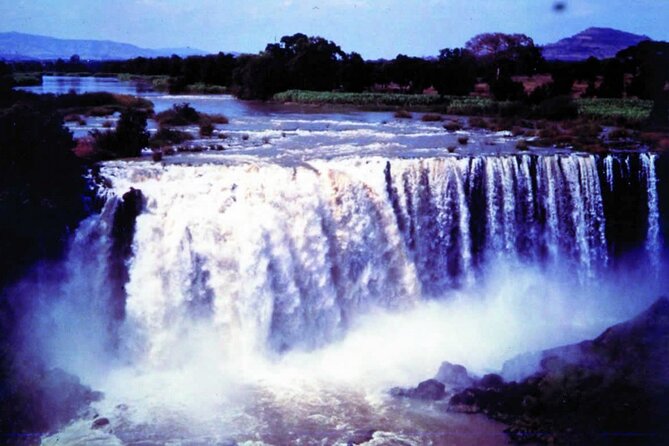
In the afternoon you go to Tisissat Falls, famously called water that smokes. This is one of those stops where you feel the value of having transport sorted. You do not want to waste time figuring out getting there and back.
Possible drawback: lake days can be cooler or breezier than you expect. Bring a light layer even if you think you are done with weather surprises.
Gondar: The Royal Enclosure and Castles That Still Look Solid
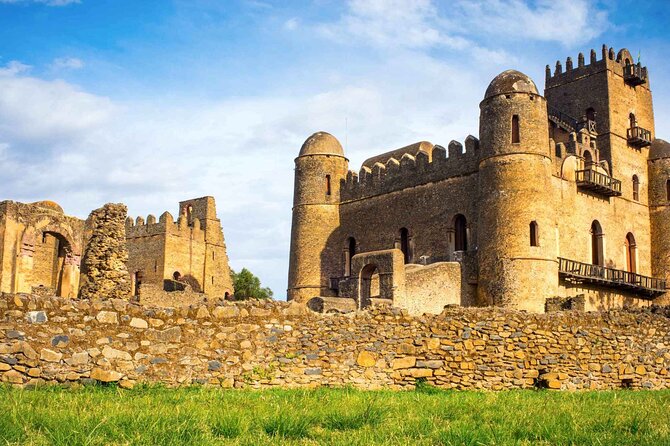
Next comes the drive to Gondar, a former capital and one of the best “old Ethiopia” cities to visit. Gondar has a walled Royal Enclosure and some of the most intact 17th-century castles in the country.
The route focuses on the big name monuments, especially the largest and best castle tied to King Fasiledas. The stone construction, round turrets, and wooden balconies are built in a style that feels sturdy rather than decorative. You can stand in the right spot and imagine how power worked here.
You also get the bathhouse idea, the Pavilion of Delight and the Bathhouse of Fasil nearby. Even if you are not in town for the Timkat festival in January, it helps to know this is a living calendar, not just a museum moment. The same structures that impressed emperors are still part of Ethiopian tradition.
Value note: Gondar is a place where the guide matters. The site is visually impressive, but context turns it from “wow” into “I get what I am looking at.”
More from Addis Ababa to consider
- Day Trip From Addis Ababa See Historical Monastery,Stunning Nature,Animals,Birds
★ 5.0 · 303 reviews - Hidden Treasures of Addis Ababa – Food, Culture and History Tour
★ 5.0 · 57 reviews - 5 Days Tour to World Heritage-listed Harrar, Dire Dawa and Awash NATIONAL PARK
★ 4.5 · 10 reviews - DAY TRIP TO THE UNESCO HERITAGE SITE TIYA & Melka Kunture
★ 4.5 · 10 reviews
Simien Mountains National Park: Geladas, Views at 3,250m, and a Real Walk Option
This is your highland day. After breakfast you drive to Debark at the edge of the Simien Mountains. In late morning you move into the mountains for views and ecosystem spotting.
There’s an optional 1.5-hour walk, mostly flat or downhill. That matters. You are not signing up for a brutal trek, but you are still getting out of the vehicle to see the environment up close. If you want chances at wildlife, this is the right kind of outing.
You can hope to see endemic gelada baboons, klipspringers, lammergeyer vultures, and bushbuck. I cannot promise any animal, but this is a strong target list for this region and altitude.
The maximum altitude mentioned is 3,250 meters, which is why this portion is included for people with moderate fitness. You should take it slow, eat something simple, and respect the altitude. If you get headaches, nausea, or shortness of breath, do not push.
Overnight is Simein Camping, so you are swapping hotel comfort for a more basic, closer-to-nature experience. This is one of those “you came for adventure” moments, but it can be surprisingly rewarding if you come prepared.
Day 5 Drive to Axum: The Long Road With the Best Photos
From Simien you travel to Axum via rugged roads, lowlands, and the Tekeze River gorge. This is a long drive day, but the point is to trade time for dramatic scenery and photo stops.
On travel days like this, you should manage expectations. You may feel like you are doing “less sightseeing” than on a walking day. But this kind of route gives you a sense of Ethiopia’s scale and variety, and it’s part of what makes the final destinations feel dramatic.
Once you arrive in Axum, you check into your hotel and get time to relax. That break is important. Axum is where tomorrow’s archaeology and church history will ask for attention.
Axum: When Christianity Starts Getting Specific
Axum is a UNESCO World Heritage Site, and it is also a key piece of Ethiopia’s ancient identity. The tour frames Axum as the seat of the Kingdom of Axum, once powerful through trade routes connecting the Mediterranean and India, plus the Red Sea port of Adulis.
You also get the religious dimension clearly. Axum is described as the origin of Christianity in Ethiopia, and there’s a tradition that the Ark of the Covenant rests here. Whether or not you treat that belief literally, it still tells you why people feel so connected to this place.
The main church anchor is St Mary of Zion, said to be the first church built in sub-Saharan Africa around 330 AD. The ruins and their placement in the precinct help you understand how old these traditions are claimed to be.
This stop is a good example of why a guided route matters. Without context, you can move through old stones and miss the bigger story. With context, the same stones feel like evidence.
Yeha and Adwa: Ilmuqah, Moon God Temples, and a Resistance Story
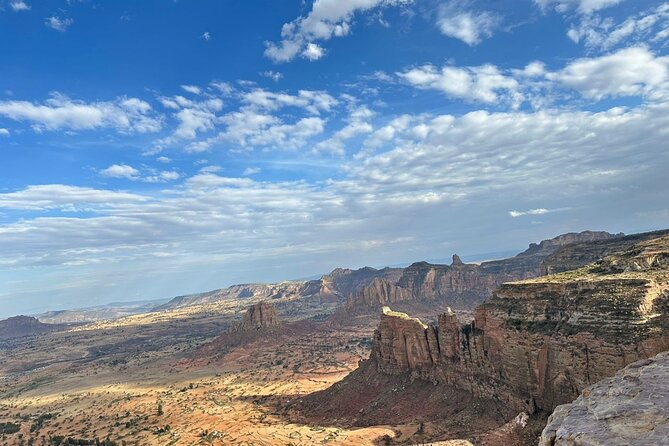
After Axum you head east toward Yeha, said to be Ethiopia’s oldest settlement, possibly dating back close to 3,000 years. Yeha’s temple is dedicated to the moon god Ilmuqah and linked through design ideas to pagan temples across the Red Sea.
Here is what I found useful in the way this day is described: the temple later becomes a church in the 6th century, but it still keeps striking friezes of ibex carved into the facade. That blend of eras is the theme of your whole trip. Old systems get reused, adapted, and turned into new meanings.
Then you visit Adwa, set among rugged mountains. The tour points out Adwa as where Ethiopians became the first African nation to repel a colonial power. Even if you already know the broad history, the geography helps, because you see how terrain and defense plans matter.
Tigray Rock-Cut Churches at Gheralta and Wukro: The Rare Kind of Site
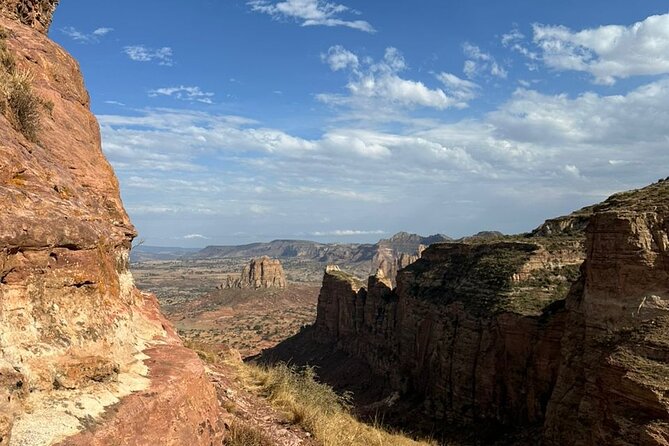
This is one of the most distinctive portions of the trip. You go into the Tigray region to see rock-cut churches that are rarely visited, and that were unknown to the outside world until the 1960s.
The tour says there are about 150 known churches, and most are still used by the Orthodox Christian community. That is a major difference from purely “frozen in time” heritage sites. Here, the architecture is old, but the faith is active.
You explore two clusters including Abreha We Atsbeha and Degum Selassie at Gheralta. Then you visit the sandstone church of Chirkos at Wukro, known for its cruciform pillars and barrel vaulted ceiling. The architectural vocabulary is there because the churches are not random cuts in rock. They show design discipline.
Why this matters for you: if you like history, but you also like being able to picture how people lived, prayed, and built before the modern era, these churches deliver.
After the church time, you drive onward to Mekele for overnight.
Lalibela Rock-Hewn Churches: The New Jerusalem in Granite
Now you come to the big finale. Lalibela is another UNESCO World Heritage Site and often the main reason people plan Ethiopia pilgrimages. Your day begins with a full morning visiting the first cluster of rock-hewn churches.
The tour describes Lalibela as the New Jerusalem, with construction believed around 800 years ago by King Lalibela. The method is what really sticks: churches are excavated on all sides of a rectangle, isolating a granite block in the center. Then the block gets shaped both inside and out. That means you are not just looking at carved walls. You are looking at a whole engineered idea made by removing the world around it.
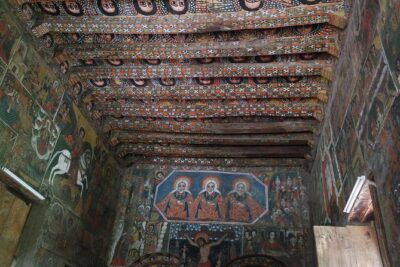
On Day 11, you visit Yimrhane Kristos, noted for interior decoration and its wooden coffer ceiling inlaid with hexagons and medallions, using figurative and geometric motifs.
Later you move to the remaining churches, including Bete Gabriel and Rafael, Merkorous, Emanuel, and Abba Libanos. Within this group, Bete Emanuel is highlighted as exceptional, with unique Axumite building features such as wall indentations, symbols of a multi-story building drawn from stelae of Axum, monkey heads, and false windows.
This is one of those moments where you may feel a little “church overload.” That is normal. The trick is to treat each church like a separate lesson, not a repeat.
Tip for you: pace yourself. Step back between carvings. Look for the design logic. Your eyes will start reading symbols rather than just seeing detail.
Addis Ababa Farewell: Entoto Mountain Views and Shiro Meda
On your final day you fly back to Addis Ababa. The tour includes sightseeing from Entoto Mountain, where you get panoramic city views and fresh air from eucalyptus forests. That altitude shift also gives your body a little reset after the long historical days.
Then you descend toward Addis Ababa via Shiro Meda, described as the city’s largest market for traditional clothes. Even if you are not there to buy, it’s a real sense of place.
In the evening you get a farewell dinner in a traditional restaurant with cultural songs, dances, and food and drinks. This is where the tour turns practical planning into a shared group memory.
Price and Logistics: Is $2,597 Worth It?
At $2,597 per person for 12 days, you are paying for more than transport. You are paying to compress time and reduce risk.
Here is where the value comes from, based on what is included:
- All domestic flights (so you are not spending days re-routing by ground)
- Private transportation in an air-conditioned vehicle (so you are not stuck in crowded public schedules)
- Professional guide (English, Spanish, French, German, Italian)
- Accommodation with breakfast, plus lunches and two dinners, and all fees and taxes
This is the kind of structure that matters in Ethiopia because you can run into bottlenecks when planning alone: long distances, uneven schedules, and the need for on-the-ground guidance.
What you should weigh: the tour is history-heavy and includes a camping night in the Simien Mountains. If you hate early starts, long drive days, or basic sleeping conditions, you will feel the trade-offs quickly.
Who This Tour Fits Best (and Who Should Think Twice)
This tour is for you if:
- You want a high concentration of historical and sacred sites in one smooth trip
- You like your history with architecture and place context, not just dates
- You appreciate small-group attention, especially on days like the Tigray rock churches
- You want hassle-free coordination, and the trip is built around that
Think twice if:
- You want lots of downtime or beach-style pacing. This route is active every day.
- You get uncomfortable with altitude, long drives, and a moderate fitness requirement. The Simien day is the main test.
The small group size also means you should go into it with a cooperative mindset. With only up to 4 travelers, the vibe stays calm, but group flexibility depends on everyone.
Should You Book This 12-Day Historical Route?
Yes, you should consider booking if your goal is to see Ethiopia’s biggest historical beats in a way that is efficient, guided, and not exhausting to plan. The route hits the major UNESCO sites you hear about, but it also spends time on the less-frequented rock-cut churches in Tigray, which is where the trip earns its special edge.
If you are the type who likes to understand what you are seeing, the guide support built into the plan will pay off. And if you care about smooth coordination, you are in good hands. Enat Ethiopia Tours and Ashu have a reputation for warm airport welcome and calm organization that makes the whole thing feel easier.
If, on the other hand, you want a softer pace, or you are not excited about church architecture and ancient sites, look for a more modern culture-focused route instead.
FAQ
How long is the 12-day Historical Route of Ethiopia?
The tour is 12 days approximately.
What is the price per person?
The price is $2,597.00 per person.
Where does the tour start and end?
It starts in Addis Ababa at the Skylight Hotel parking (Africa Avenue) and ends back at the meeting point in Addis Ababa.
Are airport pickup transfers included?
Pickup is offered, and you are transferred to your hotel after arriving in Addis Ababa.
Does the tour include flights within Ethiopia?
Yes, it includes all domestic flights.
What meals are included?
Breakfast is included for 8 days, lunch is included for 10 days, and dinner is included for 2 days.
Is there a group size limit?
Yes, the tour has a maximum of 4 travelers.
What cancellation options are available?
Free cancellation is available up to 24 hours in advance for a full refund.
Is the tour physically demanding?
It requires a moderate physical fitness level.
Newly reviewed in Addis Ababa
- Addis Ababa City Tour★ 4.5 · 3 reviews
- Full Day Addis Ababa City Tour with Hotel Pick Up And Drop Off★ 5.0 · 3 reviews
- 2 days trek around Lalibela★ 5.0 · 3 reviews
- Day Trip Around Addis Ababa★ 5.0 · 3 reviews
- Northern Ethiopia (Historic route)★ 5.0 · 3 reviews
- Day Tours around Addis Abeba, Melka Kunture and Adadi Mariam★ 5.0 · 3 reviews
- Addis Layover Tour of Mercato With Airport pick up & drop off★ 5.0 · 3 reviews
- Day Trip From Addis Ababa To Debre Ziet★ 5.0 · 3 reviews
Northern Historic Route, compared.


North Ethiopia Round Trip Tours From Addis Ababa
Read our review →
5-Day Northern Ethiopia Tour : 3D Simien Mountains Trek & Axum.
Read our review →
Northern Ethiopia & Trekking Simien Mountains , 10 Days
Read our review →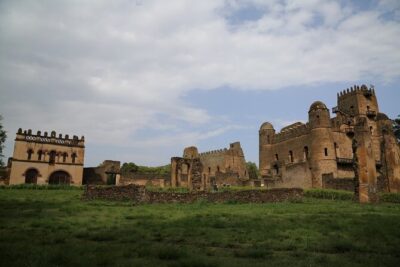
5 days Exploring North Ethiopia’s Rich History and Culture
Read our review →Browse the lists this tour appears in